
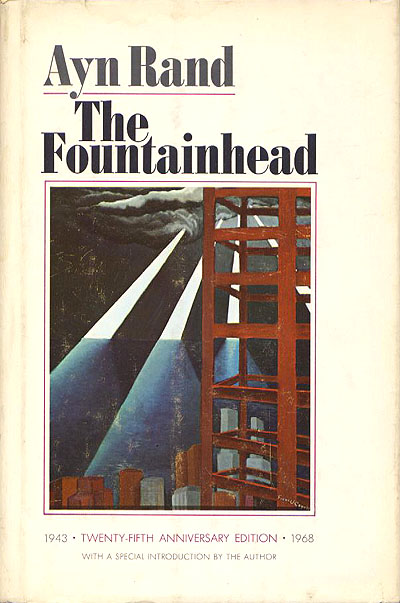
I first started getting interested in Ayn Rand through the video game Bioshock, which was very much influenced by other books that I loved. Among the list of influences that the makers drew up, was The Fountainhead, and it occurred to me that Fontaine, a main character in the videogame was a play off of the book's title.
All that aside, I started reading the book, and I was interested almost right away, even though the story is pretty drawl in the beginning. Howard Roark, the protagonist of the book, is made to be the perfect human being, the perfect man; this is not only in appearance, for he carries his built, redheaded, body with the utmost of confidence, but he is completely engrossed with his own ideals, and no one else's. He is the sole drawer of his own type of architecture, and believes that no other "old" or classic style of architecture should be mixed with any other, and that every building material has its own use. Howard Roark struggles to develop true emotion in the few buildings that are built, and through this, its full potential. This character is what interested me most in the book; Howard Roark is an architect who never folds against his beliefs, even when it costs him bankruptcy, jail time, and his love.
The book goes on to describe the struggles of Howard Roark and his ever standing thoughts and ideals. I cannot even begin to describe the true greatness of this book, although I wish I could; Ayn Rand develops her own brand of philosophy, called OBJECTIVISM, which states that "reality exists independent from consciousness; that individual persons are in contact with this reality through sensory perception; and that the proper moral purpose of one's life is the pursuit of one's own happiness." I believe this to be overly depressing at a point, but I have to stress that even though it is pretty doleful, the story and language of THE FOUNTAINHEAD is incredible.
I have to add that, this being her first large novel, she focuses on Howard Roark's reactions and life, due to the public, while her second novel (her magnum opus), Atlas Shrugged is quite the opposite (although dealing with many of the same themes); Atlas Shrugged tells the story of the public and the change that happens though the world due to John Galt. You do not meet Galt until the third part of this 1168 page book.


